A Dynasty's Answer to the Desert
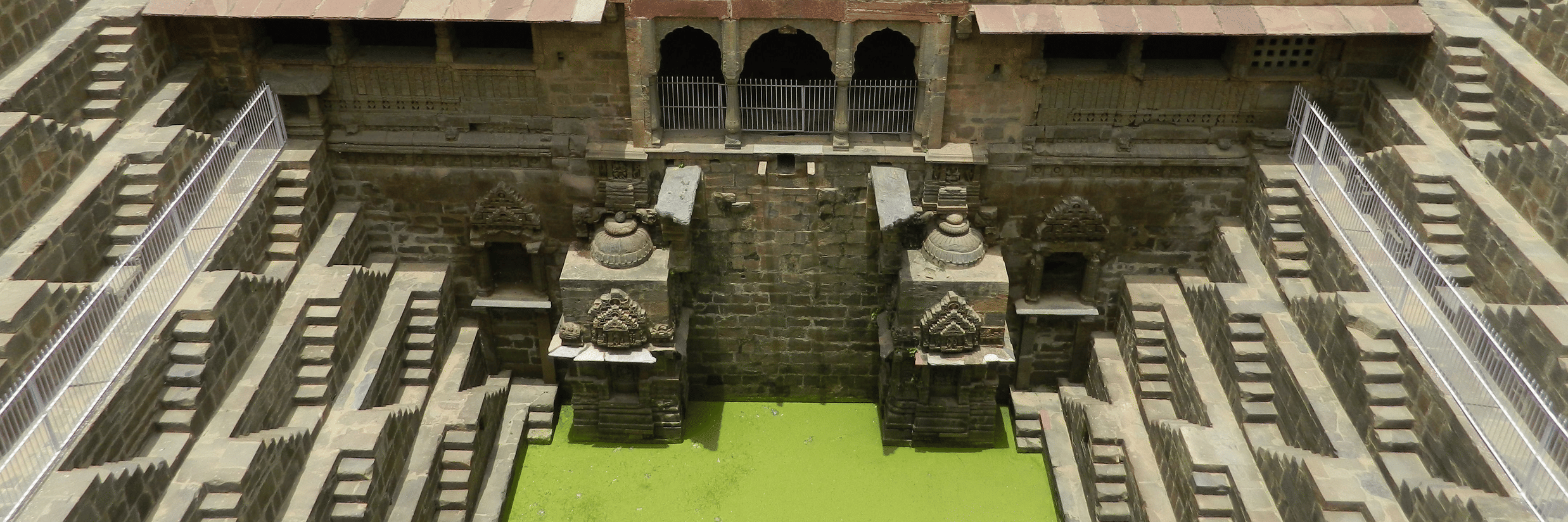
Sometime between 800 and 900 CE, Raja Chanda of the Nikumbh dynasty looked at one of India's driest landscapes and chose to go deeper rather than wider. The Abhaneri stepwell was commissioned primarily to harvest and store rainwater, with every design decision shaped by scarcity, from the sheer depth of the tank to the width of each landing that allowed cattle and villagers to descend safely during the driest months. The village itself was originally called Abha Nagri, before centuries of local dialect compressed it into its current form.
What began as a civic necessity became something more layered over time. Air at the bottom stays 5-6 degrees Celsius cooler than at the surface, drawing locals to the lower landings during summers that regularly cross 45 degrees Celsius above ground. One side houses a haveli pavilion and resting chamber reserved for the ruling family, quietly reminding everyone who drew water here exactly who owned the well.
What began as a civic necessity became something more layered over time. Air at the bottom stays 5-6 degrees Celsius cooler than at the surface, drawing locals to the lower landings during summers that regularly cross 45 degrees Celsius above ground. One side houses a haveli pavilion and resting chamber reserved for the ruling family, quietly reminding everyone who drew water here exactly who owned the well.
The Art & Geometry of 3,500 Steps
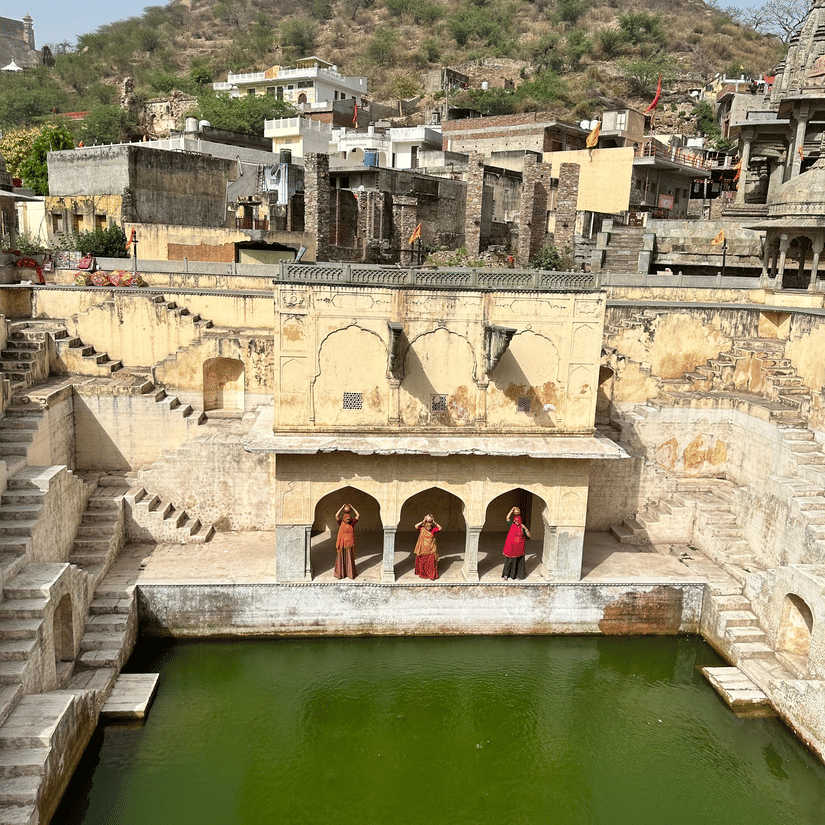
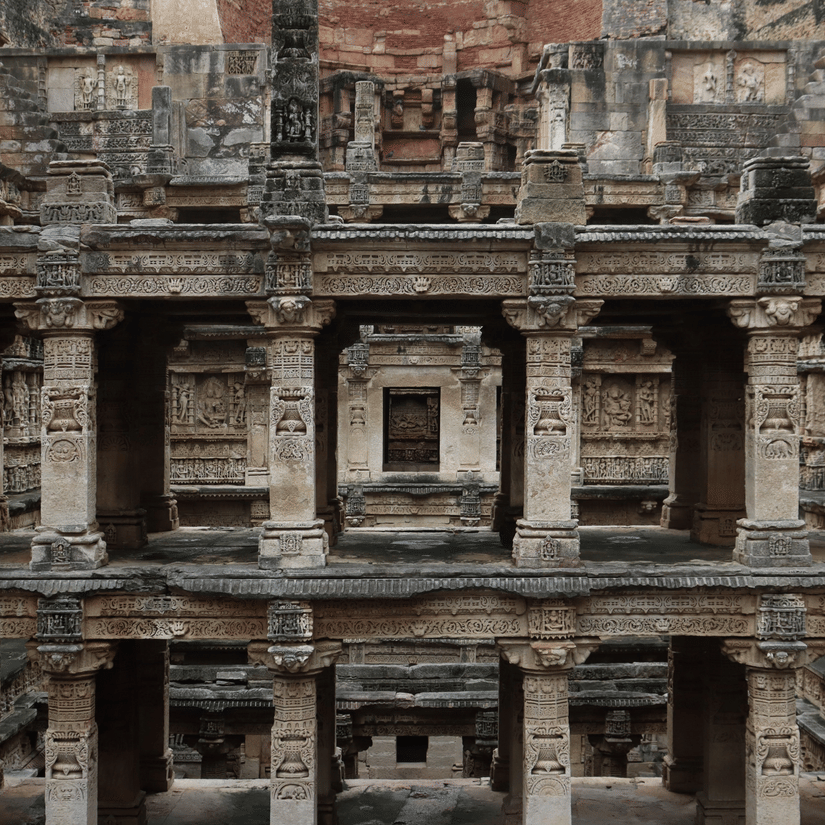
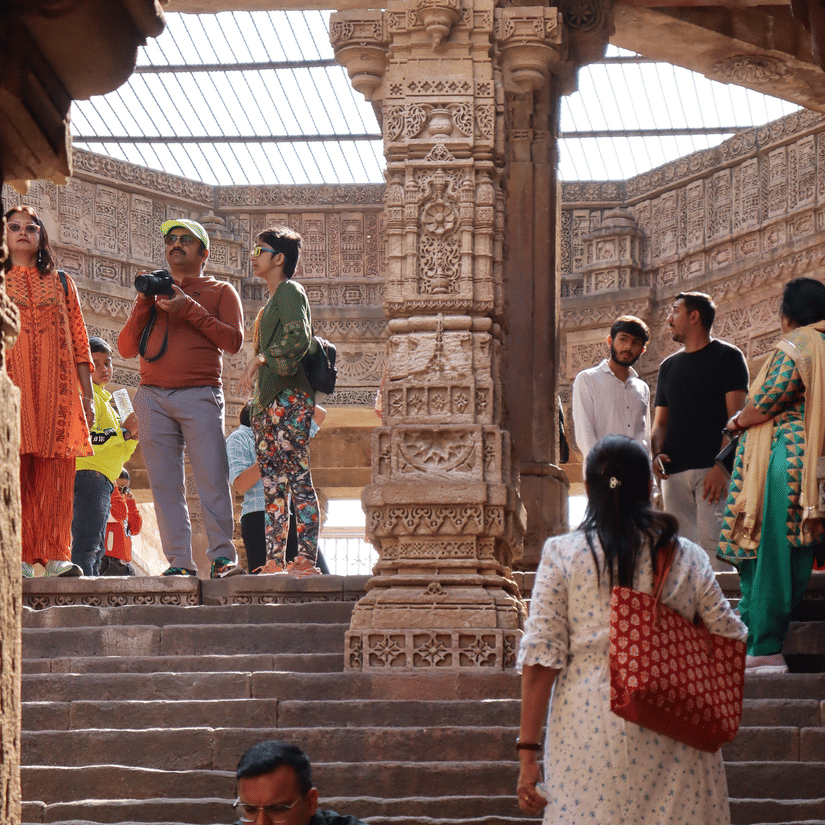
3 of the 4 sides descend in cascading staircases, each flight narrowing as it drops, creating the inverted pyramid silhouette that Indian architectural texts classify as a 'vijay vapi'. The 4th side breaks the symmetry with multi-storeyed pillared corridors, carved niches housing a Ganesha shrine, and depictions of Mahishasuramardini, Uma-Maheshwara, and Simhavahini Durga, corridors that once sheltered pilgrims travelling between temple towns across Rajasthan.
What makes the geometry truly striking is the diamond-setting pattern of the steps when viewed from above, a lattice of triangular staircases so precise it appears almost digital. No 2 adjacent flights run in the same direction, a design choice that prevented crowds from funnelling into a single bottleneck at the water level. That same functional logic is what draws architecture students and photographers today, and it is precisely why morning light between 7:00 AM and 9:00 AM produces the sharpest shadow contrasts across the entire structure.
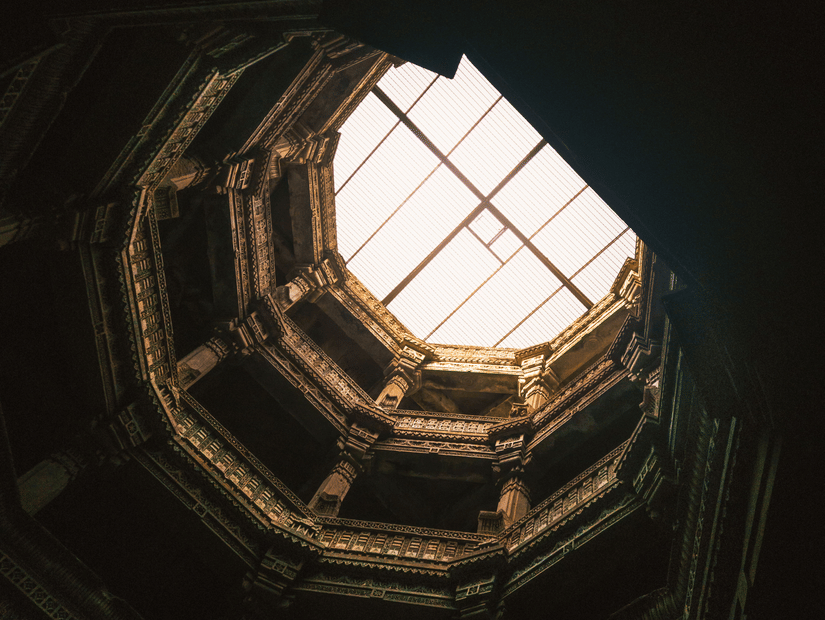
The Stepwell that Stole the Spotlight
The stepwell's cinematic career began with Paheli (2005), India's official submission to the 79th Academy Awards, a Shah Rukh Khan fantasy set against the sweeping folk landscapes of Rajasthan. Tarsem Singh's The Fall (2006) brought Chand Baori to a global audience, its geometry captured in wide aerial shots that circulated across architecture blogs worldwide. Bhool Bhulaiyaa and Bhoomi followed, both drawn by the same visual scale that no studio set could replicate at that depth.
The most discussed credit remains The Dark Knight Rises (2012), where the ‘prison pit’ scenes echo the stepwell's shape closely enough to spark location rumours. Production records confirm that the pit was a studio build inspired by Chand Baori rather than shot on location, but the resemblance prompted a measurable spike in international visitor searches that local guides still reference during morning tours.
The most discussed credit remains The Dark Knight Rises (2012), where the ‘prison pit’ scenes echo the stepwell's shape closely enough to spark location rumours. Production records confirm that the pit was a studio build inspired by Chand Baori rather than shot on location, but the resemblance prompted a measurable spike in international visitor searches that local guides still reference during morning tours.
2 Monuments, One Sacred Complex
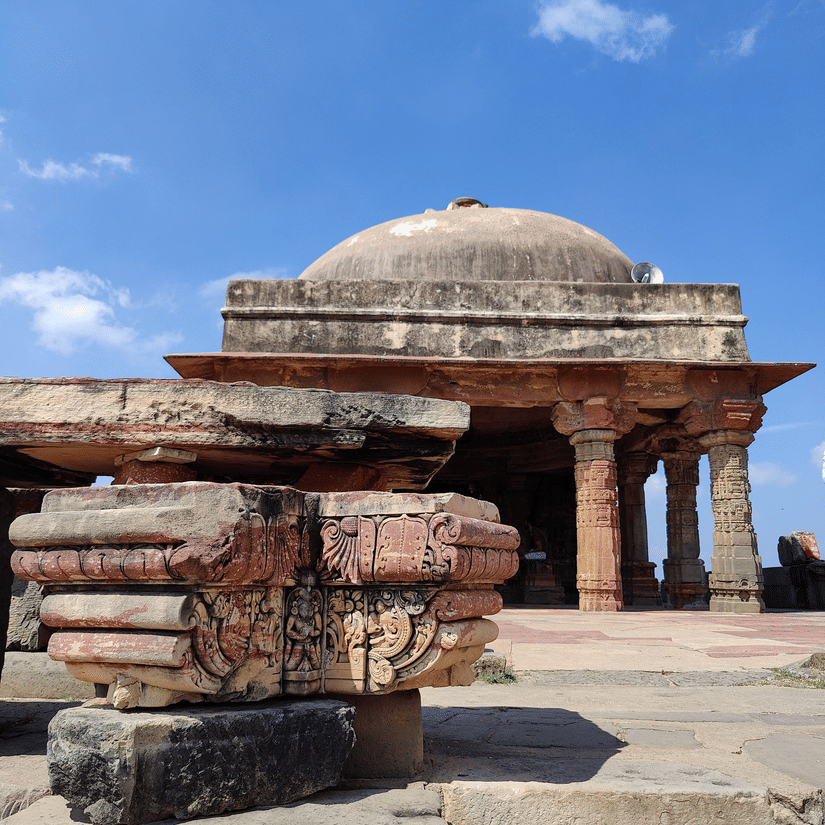
Directly adjacent to Chand Baori stands the Harshat Mata Temple, built in the panchayatana style under the Gurjara-Pratihara architectural tradition in the early 9th century. The Archaeological Survey of India protects the site, and the temple still functions as an active place of worship. Its original shikhara tower was replaced by a dome over the centuries, and many carved panels were relocated to museums in Amber and Jaipur, though enough detail survives on the platform to reward a slow walk around the base.
The temple currently houses an idol of the goddess Harshat Mata, installed after an earlier idol was stolen from the premises. Historians attribute the original construction to a Gurjara-Pratihara king, possibly in association with a local Chahamana vassal, placing the earliest carvings within the same century as the stepwell itself. Most visitors never cross the short path to reach it, missing the fact that the 2 structures were always conceived as a single sacred complex.
The temple currently houses an idol of the goddess Harshat Mata, installed after an earlier idol was stolen from the premises. Historians attribute the original construction to a Gurjara-Pratihara king, possibly in association with a local Chahamana vassal, placing the earliest carvings within the same century as the stepwell itself. Most visitors never cross the short path to reach it, missing the fact that the 2 structures were always conceived as a single sacred complex.
Visitor Details at a Glance
- Chand Baori Timings: Approximately 7:30 AM - 6:30 PM, open daily (subject to change)
- Entry Fee: Free for Indian nationals
- Foreign Nationals: INR 250 (verify current rates at the ticket counter before the visit)
- Best Photography Window: 7:00 AM - 9:00 AM, when east-facing sunlight creates the sharpest shadow geometry across the cascading steps
- Accessibility: The site is open-air and flat at ground level, but descending into the stepwell involves narrow, uneven stairs with no handrails
- Guides: Local guides are available at the entrance for a negotiable fee, typically between INR 200 and INR 500
- Parking: A small parking area is available near the entrance at no charge
- Estimated Visit Duration: 45 minutes to 1 hour for the stepwell and the adjacent Harshat Mata Temple combined

Distances from Chand Baori
- Harshat Mata Temple:Adjacent to the stepwell, within walking distance
- Mehandipur Balaji Temple:Approximately 25 km, around 46 minutes via NH 21
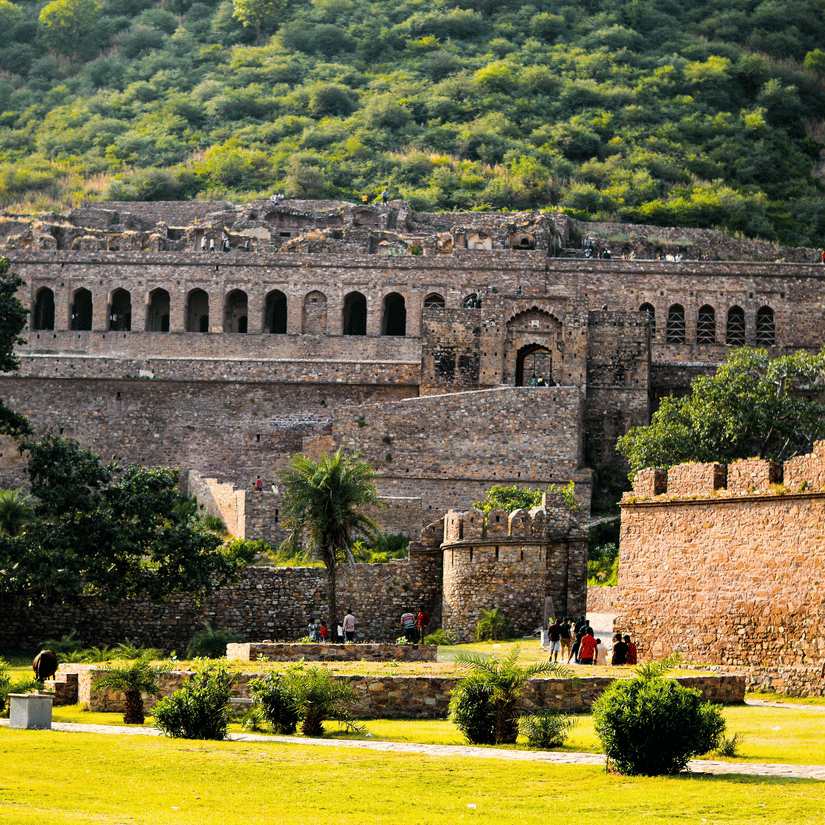
- Bhangarh Fort:Approximately 64 km, around 1 hour 23 minutes via Narayani Mata Road
For travellers driving in from outside the district, Jaipur is approximately 101 km (around 2 hours via the Jaipur-Bandikui Expressway), Delhi is approximately 266 km (around 4 hours 18 minutes via NE 4), and Agra is approximately 156 km (around 2 hours 46 minutes via Bikaner-Agra Road). Bandikui Junction, the nearest railway station with connections to both Jaipur and Delhi, sits roughly 6 km from Abhaneri village.
The Heritage Base Camp for Abhaneri
Umaid Palace sits on a 20-acre estate overlooking Kalakho Lake, approximately 21 km from Chand Baori via NH 21. Originally built in the 1970s as a hunting lodge for Thakur Umaid Singh Rathore of the Champawat Rajput clan, the property has since been converted into a heritage resort that preserves the estate while providing sustainable employment to the surrounding village communities in Dausa district.
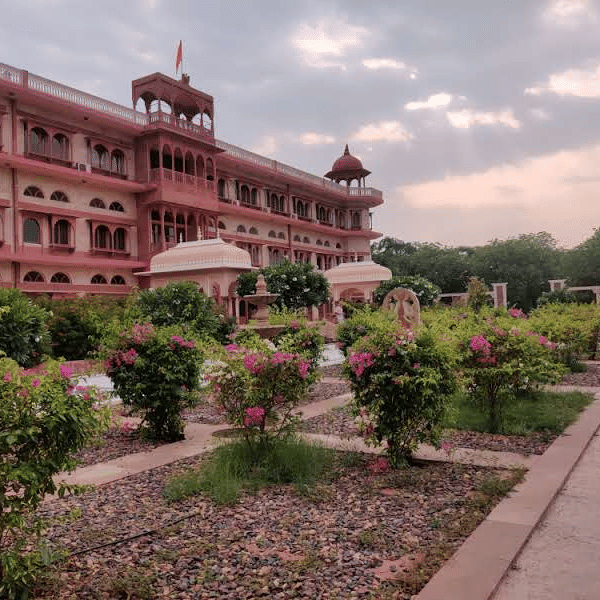
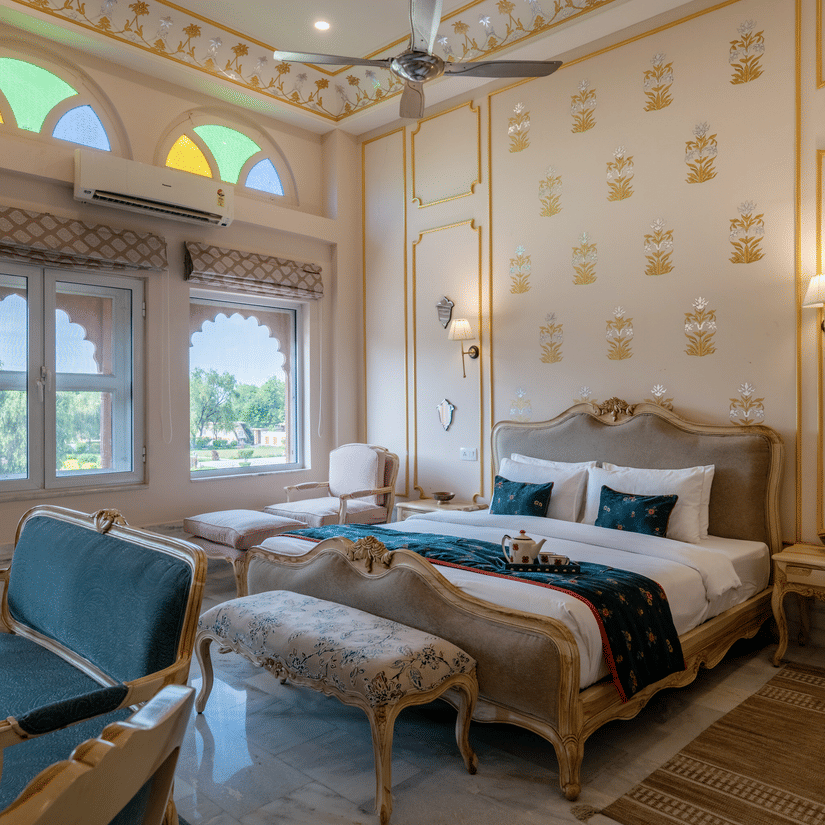
The rooms, including the Maharaja and Maharani Suites with stone-carved jharokhas and French windows, face either the lake or the Mughal-style gardens that thread through the grounds. Mornings begin at Baradari, a farm-to-table dining space drawing produce directly from the on-site organic farm and dairy, while evenings wind down at Manvar, the bar that looks out over the front lawns as the light fades. For travellers spending a full day across Abhaneri, Bhangarh, and Mehandipur Balaji, a heritage property this close to the circuit means the day can stretch as long as it needs to, without the pressure of racing back to Jaipur before dark.